
How Tadej Pogačar Will Win Milan-Sanremo
Overcoming the Milan-Sanremo Hurdle
The Prevailing Skepticism Surrounding Pogačar’s Chances
Despite his unquestioned status as cycling’s most dominant rider, a curious narrative has formed around Pogačar and “La Classicissima.” Many analysts and fans believe the race simply doesn’t suit his strengths. His previous attempts have resulted in respectable but ultimately unsatisfying finishes – 5th in 2024, 4th in 2023, and 5th in 2022. For a rider accustomed to standing atop podiums, these results are viewed almost as failures, fueling the perception that Milan-Sanremo may be his white whale.
The conventional wisdom suggests that Milan-Sanremo’s relatively flat profile, with its decisive climbs coming only in the final 30 kilometers, doesn’t provide enough elevation gain for Pogačar to drop his rivals. The race has historically favored sprinters or puncheurs who can survive the Cipressa and Poggio climbs before unleashing their finishing speed.
The Case for Pogačar’s Victory
Challenging the Notion of an Unwinnable Race
Here’s a bold prediction: 2025 will be the year Tadej Pogačar finally conquers Milan-Sanremo. This isn’t merely wishful thinking – it’s a calculated assessment based on Pogačar’s evolving racing style, his team’s strengthened roster, and the strategic approaches that could transform his fortunes in this elusive classic.
What many overlook is Pogačar’s remarkable versatility. This is a rider who can win week-long stage races, three-week Grand Tours, hilly classics, and even the World Championships on a punchy circuit. His inability to win Milan-Sanremo so far seems more like a statistical anomaly than a fundamental limitation of his abilities.
The Strategic Roadmap to Victory
Early Teamwork to Soften the Peloton
The first key to Pogačar’s future Milan-Sanremo triumph lies in his UAE Team Emirates squad’s approach to the race. Rather than waiting for the traditional finale, UAE must leverage their strength in depth to set a punishing pace much earlier than expected – ideally beginning at the Passo del Turchino, approximately 150km from the finish.
By deploying riders like Tim Wellens, Marc Soler, and João Almeida to drive the peloton over the mid-race climbs, UAE can systematically elevate the fatigue level of the entire field. This strategy would transform Milan-Sanremo from its typical “six-hour wait for a 20-minute race” format into a true test of endurance that plays to Pogačar’s exceptional recovery abilities.
A Calculated Attack on the Cipressa
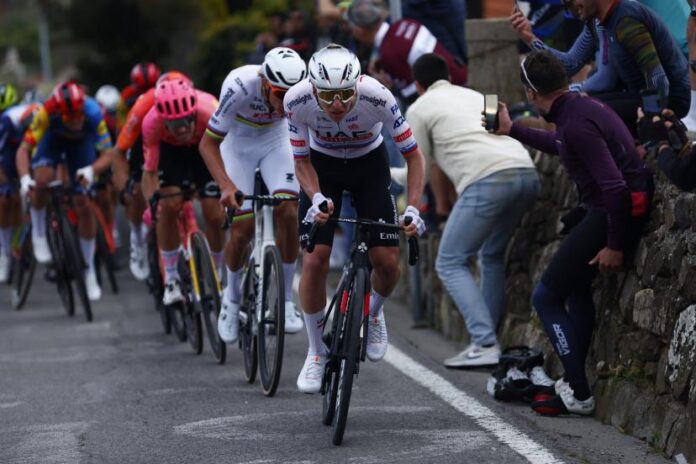
The masterstroke of this strategy would come on the penultimate climb, the Cipressa. While conventional thinking suggests the Cipressa is too far from the finish (about 28km remaining) for a successful solo move, Pogačar has the raw power to challenge this assumption.
The plan: attack at the base of the Cipressa with such ferocity that he aims to set a new record time for the climb. This wouldn’t be a tentative probe but rather a full-gas acceleration designed to create maximum separation. The element of surprise, combined with the cumulative fatigue already induced by his team’s earlier pace-setting, could leave potential chasers disorganized and psychologically defeated.
Justification for a Cipressa Attack
Critics will argue that the Cipressa isn’t selective enough, but this overlooks Pogačar’s unique capabilities. This is a rider who has repeatedly demonstrated his ability to sustain power outputs that few others can match for extended periods. The Cipressa isn’t Mount Ventoux, but in Pogačar’s legs, it could become selective enough.
Recent editions have seen fewer attempts from this point precisely because teams have become more conservative, saving everything for the Poggio. A rider of Pogačar’s caliber breaking this pattern could catch the peloton off-guard, especially if his team has already created the perfect launching conditions.
Navigating the Challenges of the Finale
Addressing Concerns About the Post-Cipressa Flat Section
The greatest challenge to this strategy is undoubtedly the flat section between the Cipressa and the foot of the Poggio, where a solo rider traditionally struggles against an organized chase. However, if Pogačar crests the Cipressa with a 30-second advantage, he would have a fighting chance to maintain much of this gap.
Furthermore, the psychological impact of seeing Pogačar disappearing up the road cannot be underestimated. Teams may hesitate, looking to each other to lead the chase, creating precious seconds of indecision that Pogačar could exploit.
The Contingency of a Reduced Sprint
Even if Pogačar is caught before the finish line, the accumulated fatigue from this aggressive racing would likely eliminate most pure sprinters. In a reduced group sprint scenario, Pogačar has demonstrated he possesses the explosiveness to outmatch most classics specialists and climbers, particularly at the end of a brutally hard race.
His sprint after 270+ kilometers of racing would be formidable against all but the most specialized finishers, many of whom would likely have been dispatched by the intensity on the Cipressa and Poggio.
Leveraging External Conditions
The Potential Advantage of Inclement Weather
An additional factor that could play into Pogačar’s hands would be challenging weather conditions. Rain-slicked roads on the technical descents of the Cipressa and Poggio would favor a solo rider over chasing groups, as Pogačar could take optimal racing lines while pursuers would face increased risks in their coordination.
Pogačar has consistently demonstrated his comfort on wet descents, and adverse conditions would only amplify the benefits of being alone at the front rather than negotiating position in a nervous group.
A New Chapter for Pogačar in Milan-Sanremo
Foreseeing the End of Pogačar’s “Tortured Relationship” with the Race
Cycling history is filled with champions who initially struggled with particular races before conquering them. Eddy Merckx didn’t win Paris-Roubaix until his third attempt. Bernard Hinault took years to master the cobbles. What defines the truly great champions is their ability to adapt, evolve, and overcome these challenges.
Tadej Pogačar stands at this crossroads with Milan-Sanremo. His “tortured relationship” with the race isn’t a permanent condition but rather a compelling chapter in what will ultimately be a story of victory. By embracing an aggressive, team-supported strategy centered on an early selection, Pogačar can rewrite the narrative and add Milan-Sanremo to his already astonishing palmarès.
In 2025, expect to see not just a different tactical approach from Pogačar, but the culmination of years of learning and adaptation. The question will no longer be if Pogačar can win Milan-Sanremo, but rather how many times he’ll claim cycling’s first Monument of the season before his career concludes.
Milan-San Remo : où Tadej Pogacar va-t-il attaquer ?
Milan-Sanremo: “Ce serait fou, même pour lui”, Pogacar va-t-il …