


Hashtags
#OlympicHockey
#WinterOlympics
#IceHockeyHistory
#NHL
#TeamCanada
#HockeyLegends
#IIHF
#OlympicsHistory
#HockeyWorld
#SportsHistory
Olympic Ice Hockey: A Century of Global Competition, Political Drama, and Athletic Excellence
Olympic ice hockey represents one of winter sports’ most compelling narratives—a Canadian invention that spread globally, became entangled in Cold War politics, evolved through professionalism debates, and ultimately emerged as a showcase for the world’s premier hockey talent. From its modest beginnings in the early twentieth century through today’s high-stakes tournaments featuring NHL superstars, Olympic hockey has consistently delivered dramatic moments that transcend sports and capture broader cultural and political tensions. The sport’s Olympic history mirrors hockey’s transformation from amateur pastime to professional spectacle, while simultaneously reflecting shifting geopolitical power dynamics and evolving perspectives on amateurism versus professionalism in international competition.
Understanding Olympic hockey requires appreciating how the sport developed across different continents with varying philosophies about training, tactics, and the proper balance between individual skill and team systems. These stylistic differences created compelling on-ice contrasts—the Soviet Union’s precision passing and disciplined positional play versus North American emphasis on physicality and individual creativity, European finesse meeting Canadian toughness. These clashes made Olympic tournaments laboratories where different hockey philosophies competed for validation through results.
Origins and Governance: From Lord Stanley to the IIHF
Ice hockey’s Canadian origins trace to the late nineteenth century when British soldiers and students adapted field hockey for frozen ponds and indoor ice rinks. The sport spread quickly through Canada’s cold-weather regions, developing local variations before standardized rules emerged. Lord Stanley of Preston, Canada’s Governor General from 1888-1893, donated the championship trophy that bears his name in 1892, establishing the Stanley Cup as hockey’s ultimate prize decades before the NHL’s founding.
The International Ice Hockey Federation (IIHF), established in 1908, brought organizational structure to international competition and eventually governed Olympic hockey tournaments. The federation’s creation reflected hockey’s rapid spread beyond Canada to European nations where the sport’s speed and physicality found enthusiastic audiences. The IIHF’s governance role became increasingly important as Olympic tournaments grew in prestige and political significance, requiring neutral administration that could navigate competing national interests and resolve disputes about eligibility, rules, and competitive formats.
The relationship between the IIHF, the International Olympic Committee, and various national governing bodies created complex political dynamics that influenced tournament formats, eligibility rules, and participation decisions. These organizational tensions periodically erupted into public controversies about professionalism, boycotts, and competitive fairness—conflicts that shaped Olympic hockey’s evolution as much as on-ice developments.
Tournament Evolution: From Canadian Dominance to Global Parity
The early Olympic tournaments (1920-1952) showcased overwhelming Canadian superiority built on the nation’s deep hockey infrastructure and cultural connection to the sport. Canadian teams won numerous gold medals during this era, often by lopsided margins that reflected the enormous skill gap between hockey’s birthplace and nations still developing competitive programs. The shift from seven-man to six-man rosters during this period represented significant tactical evolution, eliminating the rover position and creating the modern formation that persists today.
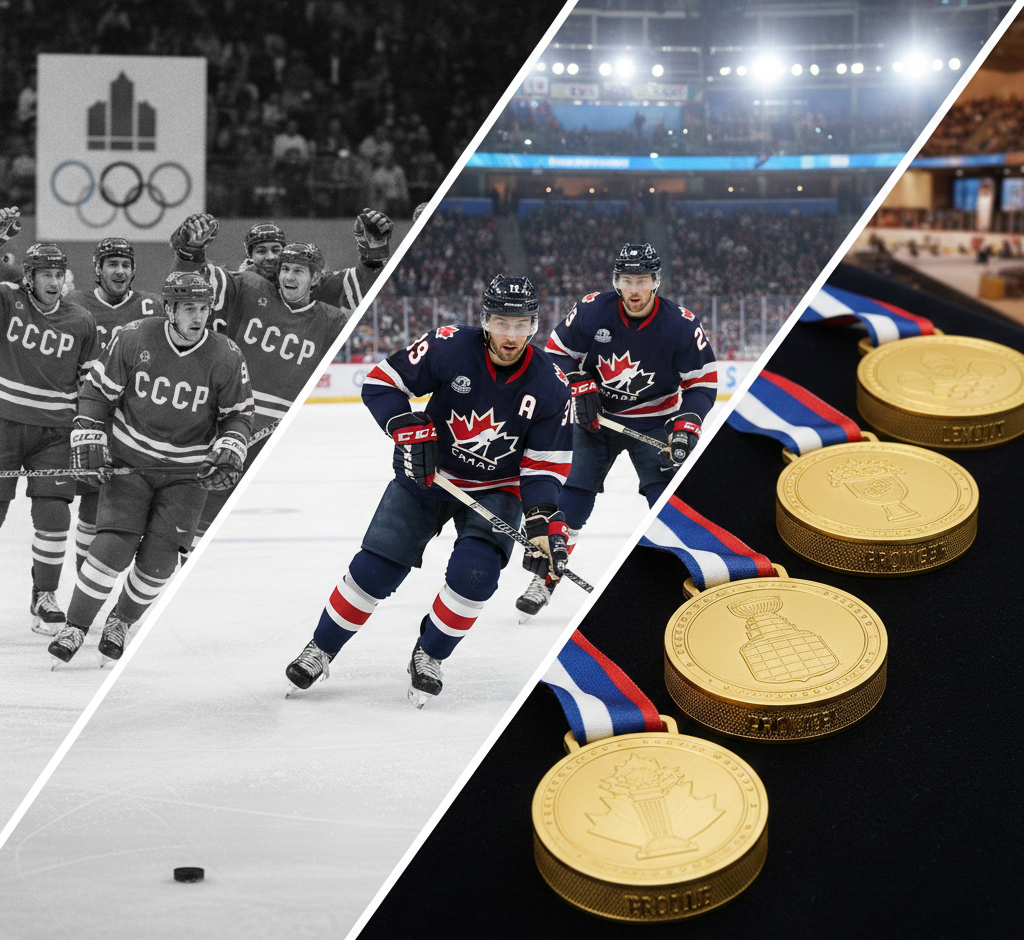
Canadian dominance began eroding as European nations, particularly the Soviet Union, invested systematically in hockey development and brought different tactical approaches to international competition. The Soviet national team’s rise (1956-1991) represented one of sports history’s most sustained periods of excellence. Their relentless success at World Championships and Olympics stemmed from state-sponsored athlete development systems that identified talented children early, provided year-round training in specialized facilities, and refined team tactics through constant practice and competition.
The Soviet approach emphasized collective play over individual stardom, tireless conditioning that maintained performance through entire games, and tactical discipline that minimized mistakes and capitalized ruthlessly on opponent errors. Their passing precision, positional rotations, and defensive responsibility created hockey that often appeared more like coordinated choreography than improvised sport. This systematic excellence produced gold medals with such regularity that Soviet victories became expected rather than surprising.
The professional revolution fundamentally altered Olympic hockey when NHL players became eligible for the 1998 Nagano Olympics. This eligibility change reflected broader Olympic movement away from strict amateurism toward accepting elite professional athletes in pursuit of showcasing each sport’s highest level of competition. The NHL’s participation created scheduling complications—the league pauses its season to release players for Olympic duty—and competitive balance issues as nations with numerous NHL players gained significant advantages over countries drawing primarily from European professional leagues.
NHL participation elevated tournament quality dramatically while creating new controversies about competitive fairness and whether Olympics should feature professionals or maintain amateur traditions. The debate continues today, with the NHL’s participation fluctuating based on complex negotiations about insurance coverage, league schedule disruption, and revenue sharing between the IOC and NHL.
Landmark Tournaments: Moments That Defined Eras
Nagano 1998 holds special significance as the first Olympics featuring NHL players and the debut of women’s Olympic hockey. The Czech Republic’s historic gold medal victory—their first major international championship—validated the professional inclusion while demonstrating that NHL talent alone didn’t guarantee victory if team cohesion and tactical execution faltered. The tournament showcased Dominik Hasek’s goaltending brilliance as he carried the Czechs through crucial games, reminding everyone that hockey remains sport where exceptional goaltending can overcome talent disparities.
The women’s tournament introduction at Nagano began what has become compelling rivalry between the United States and Canada, two nations whose women’s programs significantly outpace global competition. These early women’s tournaments often featured lopsided scores as the North American powers dominated European and Asian opponents still building competitive programs. However, the Olympics provided visibility and legitimacy that accelerated women’s hockey development globally, creating pathways for talented female players and inspiring younger generations.
Beijing 2022 delivered dramatic storylines including Finland’s first-ever Olympic gold medal—a breakthrough victory that validated decades of development investment and tactical evolution. Slovakia’s historic bronze medal represented another milestone for a smaller hockey nation, demonstrating how sustained commitment to youth development and professional league quality can elevate national team competitiveness even without large population bases or extensive hockey traditions.
The upcoming Milan Cortina 2026 Olympics generate excitement particularly around the U.S. women’s team’s recent success over Canada, suggesting potential shift in the rivalry’s competitive balance. These victories indicate American program development producing talent and tactical sophistication that challenges Canadian historical dominance in women’s hockey. Whether this represents temporary performance fluctuation or permanent competitive shift will be determined through Olympic results.
Statistical Excellence: Nations and Athletes Who Define Greatness
Canada, the Soviet Union (and its successor state Russia), and the United States dominate all-time Olympic hockey medal counts, collectively accounting for majority of podium finishes across both men’s and women’s competitions. Canada’s totals reflect their sport’s cultural significance and the extensive infrastructure supporting player development from youth through professional levels. Soviet success stemmed from their state-sponsored athletic system that treated Olympic excellence as geopolitical imperative deserving massive resource investment.
American hockey’s Olympic success reflects the sport’s growth beyond traditional northern regions into sunbelt states and increasing participation at youth levels. The “Miracle on Ice” 1980 gold medal remains defining moment in American sports history, transcending hockey to become Cold War victory symbol and inspiration for underdog athletes everywhere. That tournament’s cultural impact exceeded its athletic significance, demonstrating how sports results can crystallize broader political and cultural narratives.
Individual legends like Jayna Hefford and Hayley Wickenheiser defined women’s hockey excellence through multiple Olympic appearances and sustained dominance. Their careers provided templates for aspiring female players while demonstrating that women’s hockey could deliver athletic excellence and competitive drama rivaling men’s tournaments. Vladislav Tretiak’s goaltending brilliance anchored Soviet teams during their dominant era, establishing standards for the position that influenced generations of goalies worldwide.
These statistical leaders and legendary athletes become measuring sticks against which current players are evaluated. Their sustained excellence across multiple tournaments demonstrates that Olympic success requires not just peak performance but the ability to maintain elite standards through evolving competitive landscapes and the physical demands of international hockey.
The Triple Gold Club: Hockey’s Most Exclusive Achievement
The Triple Gold Club recognizes players who have won Olympic gold, World Championship gold, and the Stanley Cup—hockey’s three most prestigious trophies. Membership requires extraordinary career longevity, team success across different competitive levels, and often fortunate timing that places players on championship-caliber teams at multiple career stages. The club’s exclusivity—fewer than thirty members despite hockey’s long professional history—demonstrates how difficult achieving all three championships actually proves.
Country representation within the club heavily favors Canada, Sweden, and Russia, reflecting these nations’ consistent strength across all competitive levels. Canadian dominance stems from the NHL’s concentration of Canadian players and Team Canada’s regular World Championship and Olympic success. Swedish and Russian representation reflects strong national programs that regularly produce NHL-caliber talent while maintaining competitive national teams for international tournaments.

The notable absence of goaltenders from the Triple Gold Club reflects the position’s specialized nature and the difficulty of sustaining elite goaltending across the lengthy careers necessary to accumulate all three championships. Goaltenders often peak later than forwards or defensemen, potentially missing Olympic opportunities during prime years. Additionally, goaltending’s inherent variability means even elite goalies experience performance fluctuations that can prevent championship success despite overall career excellence.
Controversy and Cultural Impact: When Hockey Transcends Sport
Olympic hockey’s history includes numerous controversies that reveal how sports become entangled with politics, nationalism, and cultural identity. Notable boycotts during Cold War years saw nations refusing participation over political disputes unrelated to hockey itself. These boycotts damaged tournament credibility by removing elite competitors and reducing championships to incomplete tests of hockey excellence.
Professionalism disputes throughout the 1970s and 1980s centered on whether “amateur” Olympic competition should exclude players receiving any compensation for hockey activities. These debates reflected broader Olympic movement struggles with amateurism ideals that increasingly seemed outdated as elite athletes required year-round training incompatible with holding regular employment. Hockey’s resolution—eventually embracing professionalism—prefigured similar evolution across other Olympic sports.
The Nagano 1998 vandalism incident, where Olympic village rooms were damaged, created international embarrassment and raised questions about athlete behavior and accountability. Citizenship controversies periodically emerge when nations naturalize foreign-born players specifically for Olympic eligibility, raising ethical questions about whether such practices violate competitive spirit even when technically legal under IIHF rules.
These controversies demonstrate that Olympic hockey carries significance beyond athletic competition—it becomes venue where national pride, political tensions, and cultural values find expression through sports results and the narratives surrounding them.
Looking Forward: NHL Participation and Emerging Hockey Nations
The ongoing cycle of NHL participation negotiations creates uncertainty about future Olympic tournaments’ competitive quality. The league’s participation brings unquestionable talent upgrades but creates logistical complications and injury risks that make team owners understandably reluctant. Finding sustainable arrangements that satisfy the NHL, IIHF, IOC, and national federations requires balancing competing interests and financial considerations.
The sport’s expansion into non-traditional hockey nations like China reflects Olympic host cities’ infrastructure legacy goals and the IIHF’s desire to globalize hockey beyond its traditional geographic strongholds. These expansion efforts face significant challenges—hockey requires expensive ice facilities, extensive youth development infrastructure, and cultural connections to winter sports that warm-climate nations often lack. However, successful expansion would dramatically increase hockey’s global footprint and create new competitive dynamics as talent pools diversify.
Olympic hockey’s future likely involves continued evolution of competitive formats, ongoing negotiations about professional participation, and hopefully increased global parity as emerging nations develop competitive programs. The sport’s Olympic presence seems secure given its popularity and ability to generate compelling athletic narratives, ensuring that future generations will experience the drama, excellence, and occasional controversy that have defined Olympic hockey since its inclusion over a century ago.
Men’s ice hockey at Winter Olympics: All winners