


Summary
Hashtags
The Manchester Derby in the Post-Ferguson Era: A Data-Driven Comparative Analysis
The landscape of English football shifted dramatically on May 8, 2013, when Sir Alex Ferguson announced his retirement from Manchester United. What followed wasn’t just a changing of the guard at Old Trafford—it was the beginning of a complete power reversal in one of football’s most storied rivalries. The Manchester Derby, once a fixture where United’s dominance seemed almost guaranteed, transformed into a clash that exposed the fragility of legacy when strategic vision falters.
This analysis dissects more than a decade of post-Ferguson football, using concrete data and financial evidence to understand how Manchester City ascended while their neighbors struggled to maintain relevance. The numbers tell a story that passion alone cannot obscure: success in modern football demands more than history and tradition. It requires systematic planning, tactical coherence, and the ruthless efficiency to turn financial investment into silverware.
The Historical and Strategic Turning Points
Sir Alex Ferguson’s 25-year tenure at Manchester United established a benchmark that may never be replicated in football management. Thirteen Premier League titles, five FA Cups, and two Champions League trophies created an expectation of perpetual excellence. Ferguson didn’t just win trophies—he built self-sustaining systems where aging squads regenerated through academy talent and shrewd transfers, where tactical adjustments happened seamlessly across seasons, and where the manager’s authority remained unquestioned regardless of boardroom changes.
The succession challenge United faced was always going to be daunting, but few anticipated the institutional collapse that followed. Ferguson’s retirement exposed an uncomfortable truth: much of United’s success was built on the singular genius of one man rather than sustainable club infrastructure. When that pillar disappeared, the entire structure wobbled.
Across Manchester, a different transformation was unfolding. The 2008 acquisition by Abu Dhabi United Group didn’t just inject capital into Manchester City—it imported an entirely new operational philosophy. The club underwent comprehensive modernization, from youth academy facilities to data analytics departments, from global commercial partnerships to medical and sports science innovations. This wasn’t simply a wealthy owner buying success; it was a nation-state deploying resources to establish a football institution that could compete with Europe’s historic giants.
The derby itself carries significance beyond ninety minutes of football. Rooted in geographical proximity and working-class identity, this fixture represents competing visions of what a football club should be. United embodied tradition, history, and organic growth. City represented ambition, innovation, and the accelerated timelines that financial power enables. Understanding this clash requires looking beyond scorelines to examine the philosophical divide separating these institutions.
Comparative Performance Metrics (2013-2024)
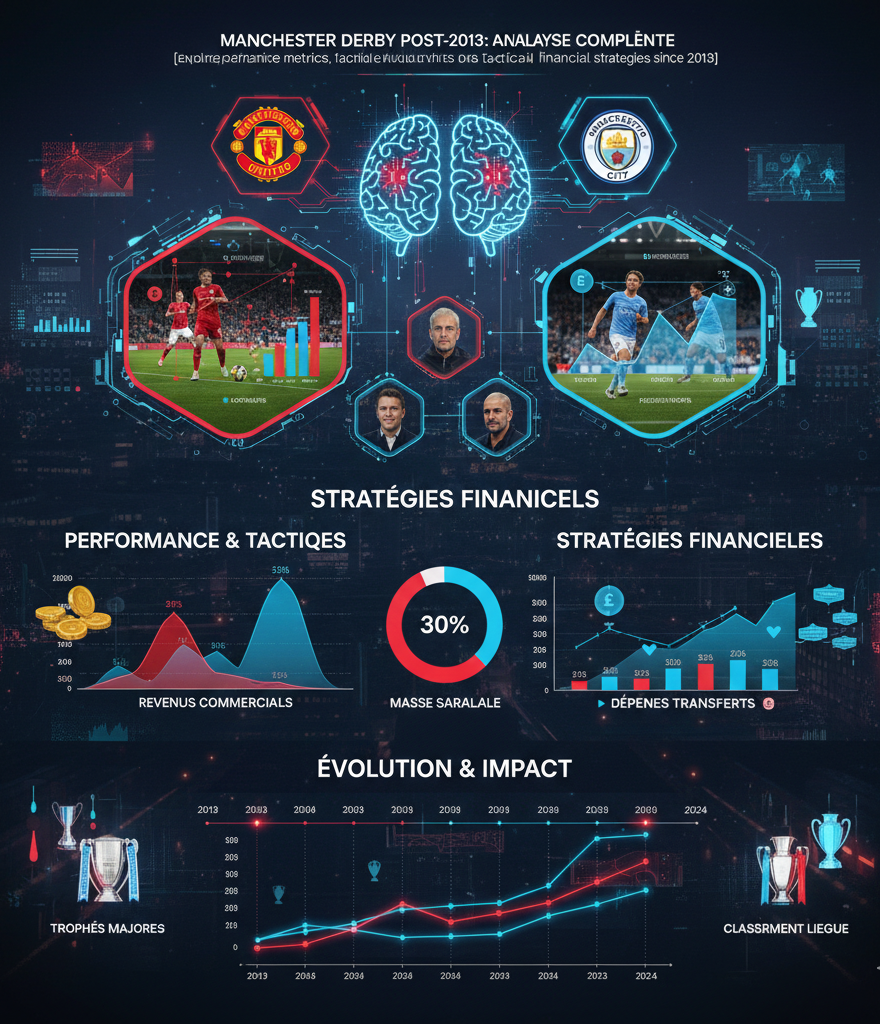
The data from the post-Ferguson era paints a picture of sustained dominance that statistical analysis makes impossible to ignore. Manchester City averaged 2.42 goals per game during this period, while United managed just 1.61. This gap isn’t marginal—it represents a fundamental difference in attacking potency that compounds over a 38-game season into an additional 30 goals scored.
Possession and passing accuracy reveal even starker contrasts. City’s mean passing accuracy of 87.73% combined with average possession figures of 63.64% demonstrates a team built to control matches through technical superiority. These aren’t vanity statistics—they translate directly into limiting opposition opportunities while creating consistent attacking platforms. United’s more variable approach to possession reflected the tactical inconsistency that plagued multiple managerial regimes, with some coaches prioritizing counter-attacking football while others attempted possession-based systems without the personnel to execute them.
Defensive metrics expose where City truly separated themselves from their rivals. Under Pep Guardiola’s system, City reduced goals conceded to as low as 0.61 per game during certain seasons—a figure that approaches the theoretical limits of defensive performance at the highest level. United’s defensive record fluctuated wildly depending on managerial philosophy, from Jose Mourinho’s pragmatic low blocks to Ole Gunnar Solskjaer’s higher defensive lines that left space in behind. This inconsistency meant United could never build the defensive foundation that championship teams require.
These numbers don’t exist in isolation. They reflect coaching quality, player recruitment alignment with tactical systems, and the compounding benefits of strategic continuity. City’s metrics improved consistently year over year as Guardiola refined his squad. United’s statistics resembled a sine wave, improving temporarily under new managers before reverting to mediocrity as tactical confusion set in.
Managerial Impact and Tactical Evolution
Manchester City’s decision to employ only two permanent managers since 2013—Manuel Pellegrini followed by Pep Guardiola—created the stability necessary for tactical evolution rather than revolution. Pellegrini established the possession-based foundation that Guardiola later perfected, ensuring philosophical continuity even during the transition. Players understood their roles within a coherent system that emphasized technical ability, positional discipline, and intelligent movement.
United, by contrast, cycled through five permanent managers and three interim appointments, each bringing contradictory tactical ideologies. David Moyes favored traditional width and crossing. Louis van Gaal implemented rigid positional play. Jose Mourinho returned to pragmatic counter-attacking football. Ole Gunnar Solskjaer attempted a high-pressing system. Erik ten Hag introduced yet another interpretation of possession football. This managerial carousel created tactical whiplash where players signed for one system found themselves miscast in another, leading to bloated squads full of talented individuals who didn’t complement each other.
Formation preferences illustrate this divergence clearly. Multiple United managers defaulted to the 4-2-3-1 formation, treating it as a safe tactical starting point rather than a system built around specific player strengths. Guardiola, meanwhile, utilized formations ranging from 4-3-3 to 3-4-2-1, adjusting based on opposition weaknesses and available personnel. This tactical flexibility stemmed from players who understood multiple roles within a coherent philosophical framework rather than rigid positional assignments.
The impact of this instability extends beyond match results to player development and squad harmony. Young players at City knew what skills to develop and what tactical intelligence the club valued. At United, academy graduates entered a first team where expectations changed with each managerial appointment, stunting development and eroding confidence.
Financial Strategy and ROI
Both Manchester clubs spent astronomical sums during the post-Ferguson era, each surpassing £1.4 billion in transfer expenditure. Yet the return on investment couldn’t be more different. Manchester City converted that spending into 16 major trophies, including multiple Premier League titles and domestic cups. United managed just five trophies, most of lesser significance, despite similar financial outlay.
The difference lies in what football analytics terms “systematic player fit”—acquiring talent that complements existing squad members and suits the tactical system rather than chasing marquee names regardless of positional need. City’s recruitment identified players like Bernardo Silva, Rodri, and Ruben Dias who slotted seamlessly into Guardiola’s system. United’s scattergun approach brought in world-class talents like Paul Pogba, Alexis Sanchez, and Cristiano Ronaldo without clear plans for how they’d function together, resulting in expensive bench warmers and discounted sales.
Investigation into ownership structures and offshore finance reveals additional complexity. Research identified City as ranking first in the “Offshore League” due to UAE-based financial arrangements and high secrecy scores in ownership documentation. United, despite different ownership structures, held the highest total volume of offshore finance at over £1 billion, demonstrating how both clubs navigate complex international financial frameworks.
Financial Fair Play regulations were designed to prevent exactly the kind of unlimited spending that nation-state ownership enables, yet enforcement has proven inconsistent. City faces ongoing scrutiny regarding sponsorship valuations and related-party transactions, while questions persist about whether commercial deals reflect genuine market value or inflated arrangements designed to circumvent spending limits. These debates extend beyond Manchester to fundamental questions about football governance and whether competitive balance remains possible when clubs can access sovereign wealth.
The post-Ferguson Manchester Derby teaches lessons that extend far beyond two football clubs. Success in modern elite sport requires alignment across every institutional level—from ownership providing resources and stability, to sporting directors identifying talent that fits tactical systems, to coaches implementing coherent philosophies, to players executing roles within that framework. When these elements synchronize, as they have at Manchester City, the results speak for themselves through both trophies and underlying performance metrics.
Manchester United’s struggles illustrate how quickly historical success becomes irrelevant without strategic adaptation. The club possessed financial resources comparable to City, maintained global commercial appeal, and could attract top-tier talent. What they lacked was the institutional patience to implement a long-term vision and the ruthless decision-making to remove obstacles to that vision.
The future of this derby continues evolving as both clubs adapt to new realities. Data analytics now inform everything from player recruitment to in-game tactical adjustments. Global fanbases measured in hundreds of millions create commercial opportunities that dwarf traditional revenue streams. Regulatory frameworks struggle to keep pace with creative financial engineering and nation-state involvement in club football.
For United, the path forward demands what has eluded them for over a decade: a unified strategic framework that extends beyond individual managers to create sustainable success. Whether current leadership possesses the vision and competence to build such a framework remains the defining question at Old Trafford. For City, the challenge shifts to maintaining dominance while navigating regulatory scrutiny that could fundamentally alter their operational model.
The data doesn’t lie. Over eleven years, one club built a dynasty while the other chased ghosts of past glory. Understanding why requires looking beyond individual matches to examine the systems, philosophies, and strategic decisions that compound over time into either excellence or mediocrity. The Manchester Derby will continue captivating millions, but the underlying story remains unchanged: in modern football, tradition without adaptation guarantees only one thing—irrelevance.
No cups, no Europe, 40 matches: is this Manchester …