


Hashtags
India Weather Forecast: Western Disturbance to Bring Relief as Temperatures Rise Across the Nation
Weather patterns across India are shifting dramatically as February progresses, with meteorological systems poised to deliver significant changes to temperature profiles and precipitation patterns throughout the subcontinent. A cyclonic circulation currently influences atmospheric conditions while a Western Disturbance approaches, promising to alter the weather landscape for millions of residents from the Himalayan regions to the southern peninsulas.
National temperature patterns reveal departures from historical norms that paint a complex picture. Some regions experience cooler conditions than seasonal averages while others register warmer readings, creating a patchwork of microclimates that challenge simplified weather narratives. Rainfall departures similarly show regional variations, with certain areas receiving above-average precipitation while neighboring states remain parched and dusty under predominantly dry skies.
Understanding these patterns matters enormously for farmers planning agricultural activities, event organizers scheduling outdoor gatherings, travelers mapping journeys across diverse terrain, and ordinary citizens simply trying to dress appropriately and plan their daily routines. Weather in India doesn’t follow simple scripts—it demands attention to regional nuances and evolving forecasts that can shift with surprising speed.
Retrospective: Weather Highlights of Early February
The opening days of February delivered weather events that ranged from the dramatic to the mundane, each contributing to the broader meteorological story unfolding across the nation. The Jammu-Kashmir-Ladakh region experienced significant rainfall and snowfall episodes that transformed landscapes, replenished water sources, and created both opportunities and challenges for local populations.
These precipitation events carried particular importance for regions dependent on snowpack accumulation. The water stored in mountain snowfall gradually melts throughout spring and summer, feeding rivers that sustain agriculture and urban water supplies across vast downstream areas. Adequate early-season snowfall sets the foundation for water security months later, making these February storms far more consequential than their immediate impacts might suggest.
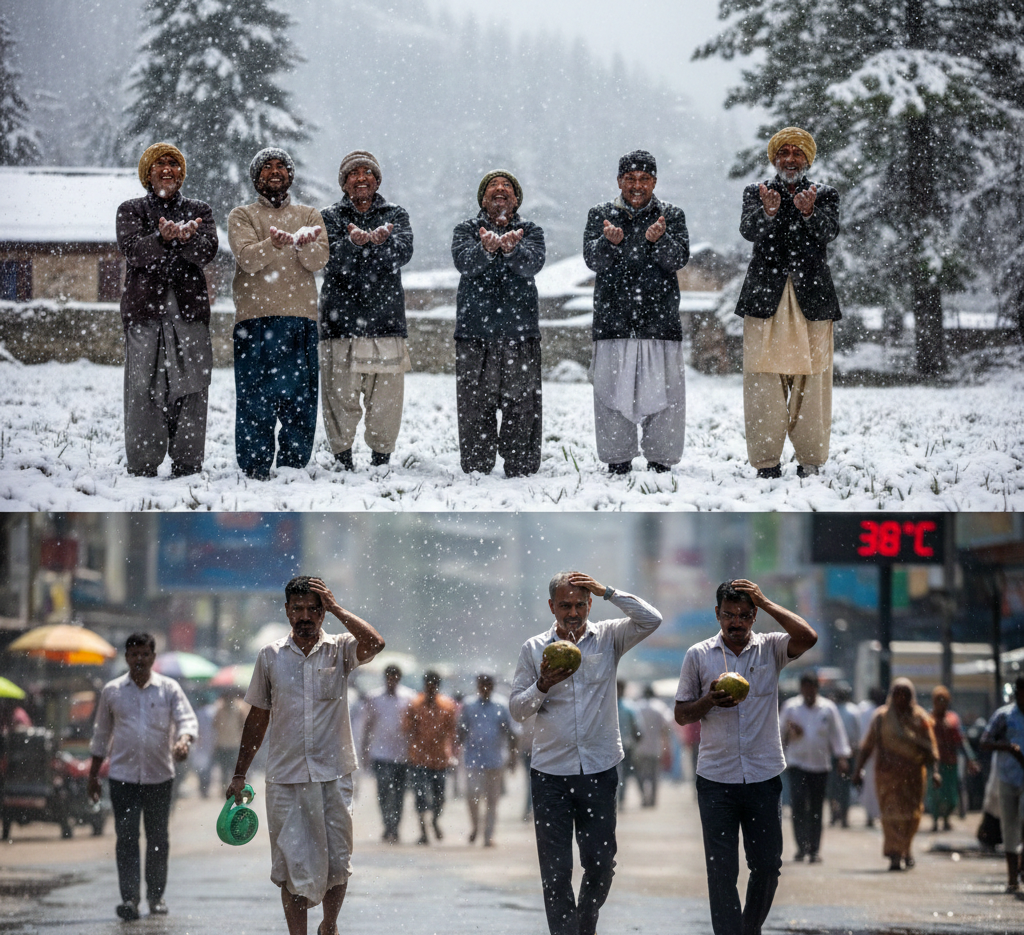
Temperature extremes during this period illustrated India’s remarkable climatic diversity within a single timeframe. Sikar in Rajasthan registered a frigid 4.5°C, temperatures that sent residents searching for additional blankets and forced adjustments to morning routines as frost covered vehicles and agricultural fields. Meanwhile, Karwar in Karnataka sweltered at 37.8°C, heat that felt more appropriate for summer than mid-winter and challenged assumptions about seasonal temperature patterns.
This 33.3°C temperature differential between locations within the same country, occurring simultaneously, demonstrates the atmospheric complexity that makes Indian weather forecasting both fascinating and challenging. The factors driving Sikar’s cold—clear skies allowing radiative cooling, continental air masses, and inland location away from moderating ocean influences—contrast completely with the conditions producing Karwar’s warmth, including proximity to the Arabian Sea, solar heating under cloudless skies, and regional pressure patterns.
These extremes weren’t merely statistical curiosities. In Sikar, the cold threatened winter crops sensitive to frost and forced vulnerable populations to seek adequate heating despite economic constraints. In Karwar, the unseasonable heat stressed residents unaccustomed to such temperatures in February and raised questions about shifting climate patterns that might make such events increasingly common.
The Road Ahead: 14-Day Forecast (Feb 12 – Feb 25)
Primary System Alert: Western Disturbance Impact
Meteorologists are tracking a Western Disturbance scheduled to influence Indian weather starting February 16th, a system that promises to deliver the most significant weather changes of the month’s latter half. Western Disturbances are extra-tropical storms originating in the Mediterranean region that travel eastward, bringing moisture-laden winds that interact with the Himalayas to produce precipitation across northern India.
The timing of this particular disturbance carries implications for multiple sectors. Agricultural communities in Punjab and Haryana monitor these systems closely, as winter rains can benefit rabi crops like wheat while excessive precipitation might complicate harvesting operations. Tourism operators in Himalayan destinations prepare for potential snowfall that attracts visitors seeking winter sports while simultaneously creating transportation challenges.
The disturbance’s expected intensity and duration will determine whether impacts remain manageable or escalate into disruptive events requiring emergency responses. Current models suggest a moderate system that will deliver beneficial precipitation without the extreme conditions that sometimes accompany more powerful disturbances, though forecasters caution that predictions made several days in advance carry inherent uncertainties.
Rainfall Outlook: Regional Variations
The Western Himalayan region stands to receive the most substantial precipitation from the approaching disturbance. Jammu and Kashmir, Himachal Pradesh, and Uttarakhand should prepare for rainfall at lower elevations transitioning to snowfall above certain altitudes. The exact elevation where rain becomes snow depends on temperature profiles that shift throughout the storm’s progression, creating dynamic conditions that can change hour by hour.
These precipitation events deliver ecological benefits alongside potential disruptions. Mountain ecosystems depend on adequate winter moisture to sustain vegetation through the dry season. Snowpack accumulation feeds streams and rivers that eventually supply water to hundreds of millions of people downstream. The precipitation also cleanses the atmosphere, temporarily improving air quality that has deteriorated through winter months.
The South Peninsula faces a different rainfall scenario. While the Western Disturbance’s direct influence diminishes with distance from northern India, peripheral effects combined with localized weather systems may trigger scattered showers across Kerala, Tamil Nadu, and Karnataka. These won’t match the intensity or coverage of northern precipitation but could provide welcome relief in areas experiencing dry conditions.
Rainfall predictions for this region remain less certain than northern forecasts, as the mechanisms driving southern precipitation involve smaller-scale convective processes that challenge forecast models. Residents should monitor updated forecasts as the period approaches, particularly if planning outdoor activities sensitive to weather conditions.
Temperature Trajectory: Warming Trend Ahead
Maximum and minimum temperatures across most of India are projected to rise by 2-4°C over the forecast period, a warming trend that will become increasingly noticeable as days progress. This temperature increase reflects multiple factors including advancing seasonal progression toward spring, changes in prevailing wind patterns, and the atmospheric effects of the Western Disturbance itself.
The warming will manifest differently across regions. Northern plains currently experiencing cool mornings will see minimum temperatures climb into more comfortable ranges, reducing heating demands and making early morning activities more pleasant. Maximum temperatures will similarly increase, though the absolute values will remain well below the scorching heat that characterizes pre-monsoon months.
Southern regions already experiencing relatively warm conditions will see temperatures push into ranges that feel decidedly summer-like despite the calendar showing mid-February. This warming may stress populations and infrastructure unaccustomed to such heat during this period, potentially increasing energy demands for cooling and creating health risks for vulnerable individuals.
The 2-4°C range represents average expectations, with specific locations potentially experiencing greater or lesser warming depending on local conditions. Urban heat island effects may amplify temperature increases in major cities where concrete and asphalt absorb and retain solar energy. Coastal areas might experience more moderate warming as ocean influences temper temperature extremes.
Environmental and Social Context
Air Quality Crisis: India’s Breathing Emergency
Air quality continues plaguing major Indian cities, with the Air Quality Index revealing dangerous pollution levels that threaten public health daily. Rudrapur tops the unenviable rankings of India’s most polluted cities, its air thick with particulates that reduce visibility, irritate respiratory systems, and contribute to long-term health consequences for residents who lack options to escape the contamination.
Mumbai, India’s financial capital and most populous city, similarly struggles with air quality that falls far short of health standards. The pollution sources are diverse—vehicle emissions, industrial activities, construction dust, and regional transport of pollutants from distant sources all contribute to the toxic atmospheric cocktail residents breathe.
The health implications are staggering. Prolonged exposure to poor air quality increases risks of respiratory diseases, cardiovascular problems, and various cancers. Children and elderly populations face particular vulnerability, their developing or declining physiological systems less capable of managing the stress that polluted air imposes. The economic costs through healthcare expenses and lost productivity compound the human suffering.
Weather patterns interact with air quality in complex ways. The approaching Western Disturbance may temporarily improve conditions through precipitation that scrubs particulates from the atmosphere and winds that disperse accumulated pollutants. However, these improvements typically prove short-lived as emission sources continue operating and atmospheric conditions eventually return to patterns that trap pollution near ground level.
Weather in the News: Impact on Major Events
Weather considerations extend beyond daily routines into major events that capture national and international attention. The T20 World Cup faces rain threats in Colombo, where unpredictable precipitation patterns could disrupt match schedules and disappoint fans who have traveled significant distances to witness cricket’s biggest stars compete on the global stage.
Tournament organizers monitor weather forecasts obsessively, ready to implement contingency plans that might include schedule adjustments, reserve days, or modified playing conditions. The uncertainty frustrates everyone involved—players who prefer consistent preparation routines, broadcasters managing complex programming schedules, and fans whose attendance plans hinge on whether matches proceed as scheduled.
Republic Day weather in Delhi presented different concerns, as the national celebration’s outdoor ceremonies and parades require favorable conditions to proceed smoothly. Clear skies and moderate temperatures allowed the festivities to unfold without weather-related complications, though planners maintain backup arrangements for scenarios where rain or extreme cold might necessitate modifications.
These high-profile events illustrate how weather influences not just individual comfort but collective experiences that shape cultural moments and national narratives. Successfully managing weather uncertainties around major events requires sophisticated forecasting, flexible planning, and communication strategies that keep participants informed as conditions evolve.
Regional Spotlights
South India: Heat and UV Concerns
Chennai residents face heat warnings and elevated UV index readings that demand protective measures for anyone spending extended time outdoors. The combination of high temperatures and intense solar radiation creates conditions where heat stress and sunburn risks escalate rapidly for unprepared individuals.
The UV index measures the strength of ultraviolet radiation reaching Earth’s surface, with higher values indicating greater potential for skin damage. Chennai’s elevated readings reflect factors including latitude positioning that places the city relatively close to the equator, atmospheric clarity that allows more UV radiation to penetrate, and the sun’s seasonal angle that intensifies radiation exposure.
Protective strategies become essential under these conditions. Sunscreen with adequate SPF ratings should be applied generously and reapplied regularly, particularly after swimming or sweating. Wide-brimmed hats and sunglasses provide mechanical protection for face and eyes. Clothing with UV-protective properties offers another defense layer, while timing outdoor activities for early morning or late afternoon hours reduces exposure during peak UV intensity periods.
Heat management requires equal attention. Hydration becomes critical as elevated temperatures and humidity increase perspiration rates that can quickly lead to dehydration if fluid intake doesn’t match losses. Recognizing early heat stress symptoms—excessive thirst, fatigue, dizziness, or reduced urine output—allows for prompt corrective action before conditions deteriorate into medical emergencies.
West India: Temperature and Humidity Dynamics
Maharashtra and Gujarat experience their own distinct weather patterns shaped by geography, prevailing winds, and seasonal transitions. Temperature profiles vary considerably within these states based on elevation, distance from coastlines, and urban versus rural settings.
Coastal areas benefit from moderating ocean influences that prevent the temperature extremes experienced inland. Sea breezes during afternoon hours provide natural cooling that makes coastal living more comfortable during warm periods. However, these same maritime influences increase humidity levels that can make moderate temperatures feel considerably warmer through reduced evaporative cooling efficiency.
Interior regions of both states experience greater temperature swings between day and night, with morning lows potentially dropping substantially before afternoon heating pushes maximums into uncomfortable ranges. The dry conditions typical of these areas mean humidity remains relatively low, allowing evaporative cooling to function effectively and making heat more bearable than comparable temperatures in humid environments.
Agricultural communities throughout these states calibrate their activities around these weather patterns. Irrigation schedules, pesticide applications, and harvest timing all depend on accurate weather understanding. The projected temperature increases and precipitation possibilities factor into countless decisions that ultimately determine agricultural productivity and rural livelihoods.
Conclusion and Safety Advisories
Outdoor Activity Guidelines
The projected weather conditions create specific considerations for anyone planning outdoor activities during the forecast period. High RealFeel® temperatures in southern regions demand that organizers of outdoor events, sporting activities, or construction projects implement heat safety protocols protecting participants and workers from heat-related illnesses.
These protocols should include frequent rest breaks in shaded areas, readily available hydration stations, modified work schedules that avoid peak heat hours when feasible, and trained personnel who can recognize heat stress symptoms and respond appropriately. The slight inconvenience of these measures pales compared to the consequences of heat stroke or severe dehydration that can prove fatal when ignored.
Fog Safety for Himalayan Travelers
Himachal Pradesh and Meghalaya travelers must prepare for fog conditions that dramatically reduce visibility and create treacherous driving situations. Mountain roads become particularly dangerous when fog obscures curves, edges, and oncoming traffic that might appear suddenly from the murk with insufficient time for safe reactions.
Safe fog driving requires reduced speeds appropriate for visibility distances, using low-beam headlights rather than high beams that reflect off fog and worsen visibility, maintaining extra following distance behind other vehicles, and being prepared to pull safely off the road if conditions deteriorate beyond safe navigation limits.
The approaching weather systems bring both opportunities and challenges across India’s diverse landscapes. Staying informed through regularly updated forecasts, taking appropriate precautions for local conditions, and maintaining flexibility in plans allows everyone to navigate the changing weather successfully while minimizing risks and maximizing the benefits that favorable conditions provide.