

Hashtags
Jung Hoo Lee: The Grandson of the Wind Brings Elite Contact and Cultural Electricity to San Francisco
The San Francisco Giants’ acquisition of Jung Hoo Lee represented a calculated gamble on translating Korean Baseball Organization excellence into Major League success—a transition that has humbled countless international stars who discovered that what works brilliantly in Asia doesn’t necessarily translate against MLB’s superior velocity, breaking stuff, and defensive positioning. Yet Lee’s 2025 breakout season has validated the Giants’ investment with performances suggesting he’s not merely surviving MLB competition but genuinely thriving, bringing an elite contact-oriented approach perfectly suited to the modern game’s strikeout epidemic. His success demonstrates that even in an era dominated by launch angle obsession and three-true-outcomes philosophy, there remains significant value in players who put the ball in play with authority, forcing defenses to make plays while creating offensive opportunities through speed and situational hitting.
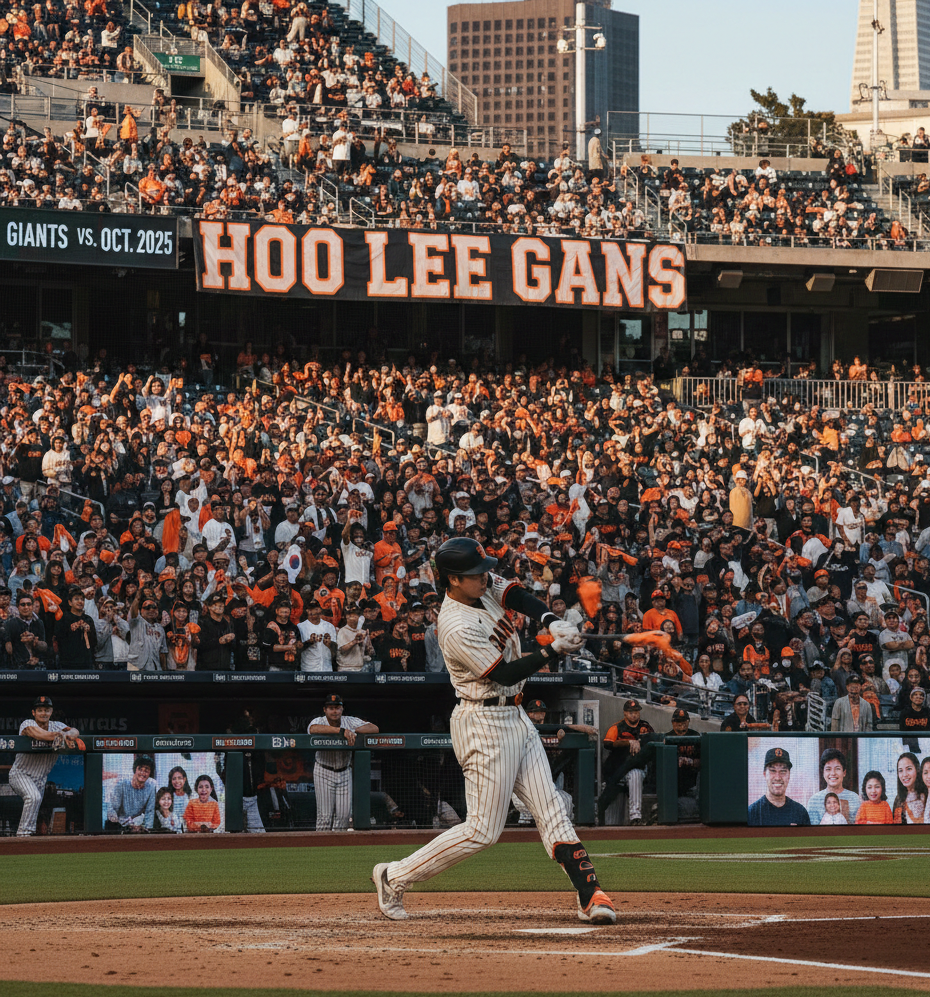
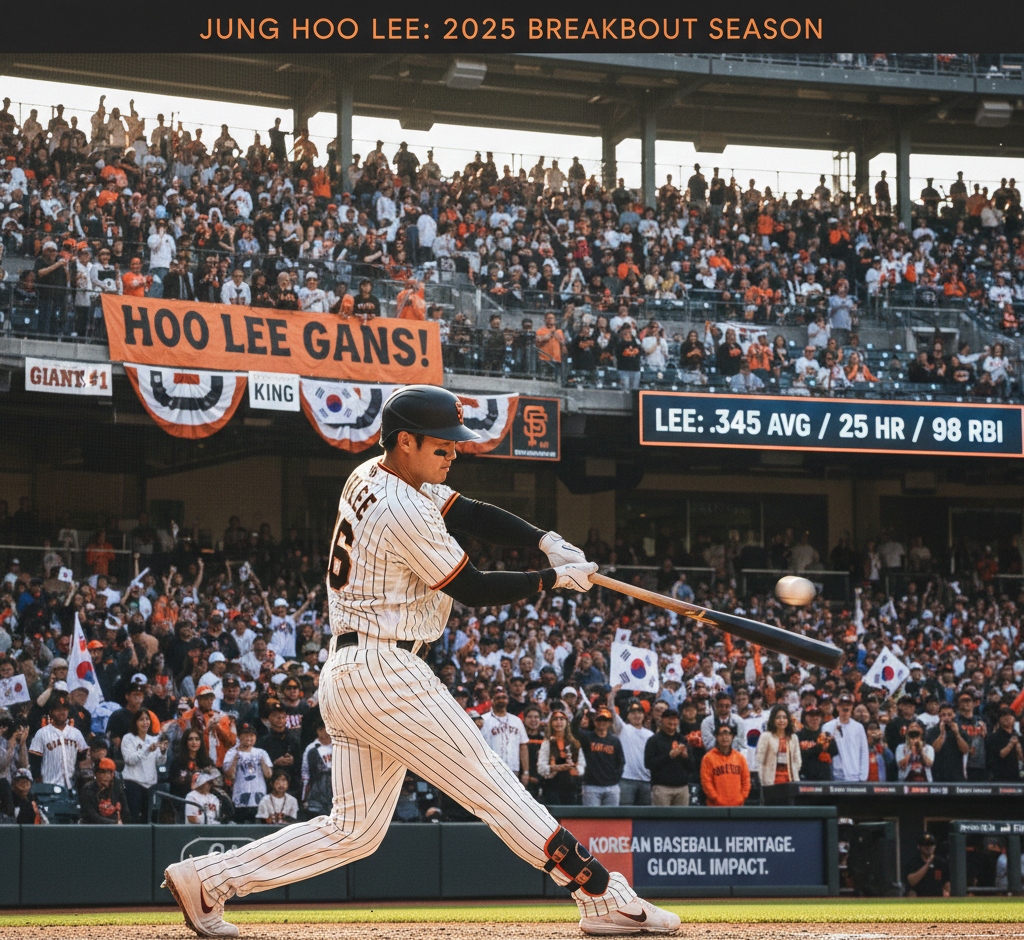
Beyond the statistics and swing mechanics, Lee has energized Oracle Park’s atmosphere through the organic fan culture surrounding him—the “Hoo Lee Gans” supporter group, Korean Heritage Night celebrations, and viral moments that have made him one of baseball’s most engaging personalities despite the language barriers that typically limit international players’ marketing appeal. This cultural impact matters enormously for the Giants, who play in one of America’s most diverse metropolitan areas with substantial Asian American populations that represent underserved markets for fan engagement and ticket sales. Lee’s success creates entry points for new baseball fans while giving existing supporters a charismatic player whose style and personality resonate beyond traditional baseball demographics.
The Arrival of Jung Hoo Lee in San Francisco and His 2025 Breakout
Jung Hoo Lee’s signing with the Giants in December 2023 generated measured excitement rather than the hysteria surrounding superstar acquisitions, reflecting both his lack of name recognition among American baseball fans and lingering questions about whether his KBO success would translate to MLB’s higher competition level. The six-year, $113 million contract represented substantial financial commitment for a player without MLB experience, but the Giants’ front office—led by President of Baseball Operations Farhan Zaidi—believed Lee’s skills would translate based on exhaustive scouting, data analysis, and confidence that his elite bat-to-ball skills addressed specific roster needs for a team that struck out too frequently while struggling to consistently put pressure on opposing pitches.
The “Grandson of the Wind” moniker carries deep significance in Korean baseball culture, representing not just Lee’s playing style but his family legacy. The nickname originated from his father Lee Jong-beom’s status as “Son of the Wind,” one of Korean baseball’s legendary figures whose speed, defensive excellence, and clutch hitting made him a national icon. The elder Lee’s 1999 season—when he hit .393 with a KBO-record 61 stolen bases—established standards of excellence that seemed impossible to match, yet Jung Hoo has carved his own legacy while honoring his father’s tradition. The “Grandson” designation acknowledges both his family lineage and his inheritance of the speed and defensive instincts that defined his father’s game.
Lee’s 2025 breakout exceeded even optimistic projections, with a slash line around .295/.355/.435 demonstrating the balanced offensive profile the Giants envisioned. More impressive than the raw numbers were the underlying metrics showing elite bat control, minimal swing-and-miss, and exceptional ability to barrel baseballs despite lacking the plus raw power that typically separates good hitters from great ones. His performance validated the Giants’ belief that contact-oriented players create value in ways that traditional power-focused scouting sometimes undervalues, generating offense through high batting averages, on-base percentages sustained by low strikeout rates, and defensive contributions that don’t appear in offensive statistics.
The Mechanics of Success: A Swing Like No Other
Step-by-Step Breakdown: The Wide-Open Stance, the Preliminary Step, and the Final Stride
Lee’s batting stance immediately distinguishes him from conventional MLB approaches, beginning with an unusually wide-open stance measuring approximately 41 degrees—his front foot positioned significantly toward the pull side rather than squared toward the pitcher. This extreme open stance creates multiple potential issues that Lee somehow transforms into advantages through precise mechanical sequencing. The open position theoretically makes covering the outer half of the plate difficult while leaving him vulnerable to inside pitches that can jam him before his swing fully develops. Yet Lee compensates through exceptional timing and the preliminary movements that follow his setup.
The preliminary step represents Lee’s signature pre-pitch movement, a small stride that appears almost like a false start before his actual swing begins. This initial movement serves multiple purposes—it creates rhythm that helps timing, provides early weight transfer that generates momentum toward the pitcher, and functions as a trigger mechanism that initiates his swing sequence. The preliminary step’s subtlety makes it easy to overlook, but biomechanical analysis reveals how this movement allows Lee to begin his swing earlier than his setup position would suggest, compensating for the extra distance his open stance creates between his body and outer-half pitches.
The final stride closes Lee’s stance dramatically, transforming his 41-degree open position into a relatively square stance as his front foot plants. This stride covers substantial ground—approximately 10-12 inches—while his upper body rotates to square his shoulders toward the pitcher. The combination creates explosive rotation through the hitting zone while his closed stride position provides leverage to drive pitches to all fields. The mechanics require extraordinary timing precision, as any mistiming in the transition from open stance through preliminary step to final stride leaves him vulnerable to good pitching that exploits the moment when his weight transfers or his swing commits before optimal contact position.
Style Comparisons: Blending Elements of Rafael Devers, Shohei Ohtani, and Freddie Freeman
Analyzing Lee’s swing through comparison to established MLB stars reveals how he synthesizes elements from multiple elite hitters into a cohesive personal approach. The Rafael Devers comparison emerges from Lee’s aggressive hip rotation and the violence of his swing once triggered—both players generate surprising power from relatively compact frames through explosive lower-body mechanics that transfer energy efficiently through the hitting zone. Devers’ tendency toward aggressive expansion outside the strike zone differs from Lee’s disciplined approach, but the core swing mechanics share DNA in how they create bat speed through rotation rather than pure physical strength.
The Shohei Ohtani parallels appear in Lee’s ability to adjust to different pitch types and locations with subtle swing modifications that allow him to handle both velocity and breaking stuff effectively. Ohtani’s two-way excellence overshadows his hitting brilliance, but his batting approach emphasizes similar priorities—putting the ball in play with authority, adjusting barrel path to match pitch trajectory, and creating hard contact across all zones rather than specializing in specific pitch types or locations. Both players demonstrate exceptional hand-eye coordination that allows them to recognize pitches early and adjust swings mid-execution, a rare skill that separates elite contact hitters from those who merely swing hard and hope.
Freddie Freeman’s influence appears in Lee’s disciplined approach and his understanding of situational hitting—when to drive balls in the air for extra bases versus when to focus on hard ground balls that advance runners or exploit defensive positioning. Freeman’s Hall of Fame trajectory has been built partly on his ability to adapt his approach to game situations, hitting differently with runners in scoring position versus leading off innings, or adjusting his swing when facing elimination pressure versus routine regular season games. Lee demonstrates similar baseball intelligence, suggesting his skills extend beyond mechanical execution into the mental aspects that separate good players from great ones.
Performance Metrics: Elite Whiff Rates and High Squared-Up Contact Rates
Lee’s swing generates elite performance metrics that validate the eye test suggesting he’s a special bat-to-ball talent. His whiff rate—the percentage of swings that miss the baseball entirely—ranked in the 97th percentile among all MLB hitters during 2025, an extraordinary achievement for a rookie adjusting to MLB’s superior stuff and velocity. This minimal whiff rate reflects both his swing mechanics that keep the barrel in the hitting zone for extended periods and his pitch recognition that allows him to avoid swinging at unhittable pitches that would induce whiffs from less disciplined hitters.
High squared-up contact rates—measuring how frequently Lee’s barrel meets the baseball flush for optimal exit velocity and launch angle—demonstrate that his contact isn’t merely defensive but genuinely productive. Many contact-oriented hitters survive through their ability to foul off tough pitches and eventually draw walks or find weakly hit balls that fall for singles, but Lee consistently barrels baseballs with authority that produces extra-base hits and hard outs that create pressure on defenses. This combination of rare swings-and-misses with frequent quality contact creates an offensive profile that’s both consistent and dangerous.
The Road to San Francisco: KBO Dominance and Rookie Challenges
Legacy in Korea: 2022 KBO MVP and Five-Time Golden Glove Winner
Lee’s Korean baseball legacy was cemented well before his MLB arrival, with accomplishments that rank him among KBO history’s elite players despite his relative youth. The 2022 KBO MVP award recognized a season where Lee dominated every aspect of the game—hitting .349 with 23 home runs, 113 RBIs, and stellar defense that earned him his fifth consecutive Golden Glove award. This sustained excellence across multiple seasons distinguished Lee from one-year wonders whose peak performances might not translate across different contexts, suggesting genuine elite skills rather than fortunate statistical outliers.
The five Golden Glove awards for defensive excellence highlight Lee’s value beyond offense, as his center field defense features exceptional range, accurate throwing, and instinctive route-running that prevents extra bases and turns potential extra-base hits into routine outs. This defensive excellence matters particularly for the Giants, who play in Oracle Park’s spacious outfield where defensive ability significantly impacts run prevention. Lee’s glove work provides tangible value even during offensive slumps, ensuring he contributes winning plays regardless of his batting line.
Injury and Recovery: Navigating the 2024 Shoulder Dislocation and Labrum Surgery
Lee’s 2024 rookie season was derailed by a shoulder dislocation suffered while attempting a diving catch, an injury that required labrum surgery and extensive rehabilitation that cost him the majority of the season. The injury timing proved particularly unfortunate, occurring just as Lee appeared to be adjusting to MLB pitching after a slow start that raised questions about whether his skills would translate. The months-long rehabilitation process tested Lee’s mental resilience as much as his physical recovery, forcing him to maintain conditioning and baseball skills while unable to compete.
The shoulder injury’s severity raised legitimate concerns about whether Lee would fully recover his throwing strength and whether fear of re-injury might make him tentative on defense or at the plate. Shoulder injuries particularly affect hitters’ ability to generate bat speed through upper-body rotation, and labrum repairs require extensive time to heal sufficiently for the violent movements that baseball demands. Lee’s 2025 breakout demonstrated complete recovery, but the lost development time from missing most of his rookie season cannot be recovered, leaving questions about what might have been if he’d enjoyed a healthy first MLB campaign.
Fan Culture and “Hoo Lee Gan” Mania
The Group: Origins of the “Hoo Lee Gans” and Their Signature Attire
The “Hoo Lee Gans” supporter group emerged organically through social media connections among Bay Area Korean Americans and Giants fans who recognized the opportunity to create distinctive fan culture around Lee’s arrival. The group’s name plays on Lee’s name while evoking “hooligan”—the term for passionate, sometimes rowdy soccer supporters—creating immediate identity that signals both enthusiasm and irreverence. The wordplay works across languages, making it accessible to English speakers while Korean speakers appreciate the linguistic creativity connecting to their cultural heritage.
The signature attire featuring fire wigs and custom “Hoo Lee Gans” shirts creates visual coherence that television broadcasts inevitably capture, amplifying the group’s visibility beyond their actual numbers in the stands. The fire wig choice references both energy and passion while creating striking visual imagery that photographs and streams well on social media. The wigs’ bright colors—typically orange and black matching Giants team colors—ensure that even small numbers of supporters create disproportionate visual impact during broadcasts.
Ballpark Atmosphere: Chants, “Korean Night,” and Lee’s Interaction with the Fanbase
The Hoo Lee Gans have developed signature chants and cheers that activate during Lee’s plate appearances, creating audio atmosphere that energizes both the player and surrounding fans. These chants blend Korean and English lyrics, creating inclusive participation opportunities for both Korean speakers and English-only fans who can learn phonetic chants even without understanding literal meanings. The bilingual approach reflects San Francisco’s multicultural character while honoring Lee’s heritage without excluding non-Korean fans from participation.
Korean Heritage Night celebrations have become Oracle Park highlights, featuring traditional Korean performances, food offerings, and promotional giveaways that attract both Korean American attendance and broader fan interest in experiencing different cultural traditions. These themed nights demonstrate how individual players can become catalysts for broader cultural engagement, creating entry points for new demographics while enriching the ballpark experience for existing fans. Lee’s active participation in these events—including addresses to fans in Korean that are simultaneously translated—creates authentic connections that transcend typical player-fan relationships.
The “Fire Wig” Controversy: Addressing Japanese Anime Connections versus Korean News Portrayals
The fire wigs’ visual similarity to Super Saiyan hairstyles from Dragon Ball Z—the iconic Japanese anime series—created minor controversy when Korean news coverage questioned whether fans were appropriately honoring Lee through Japanese cultural references rather than Korean symbols. This tension reflects the complex historical relationships between Korea and Japan, where Japanese cultural products’ popularity in Korea coexists with lingering resentments about Japan’s colonial occupation and ongoing territorial disputes.
The Hoo Lee Gans responded to criticism by emphasizing that the fire wigs represented energy and passion rather than specific anime references, and that Dragon Ball Z’s global popularity transcends its Japanese origins to become part of worldwide pop culture that belongs to all fans regardless of nationality. This defense satisfied most critics while highlighting the challenges of creating fan culture in globalized contexts where every symbol carries multiple cultural meanings and potential for misinterpretation across different audiences.
Impact on the Giants’ Future
Lineup Stability: Cementing His Role as the Everyday Leadoff Hitter
Lee’s 2025 performance solidified his role as the Giants’ everyday leadoff hitter, providing the lineup stability that championship-caliber teams require. The leadoff position demands specific skills—high on-base percentage, speed creating stolen base threats and extra bases on hits, and ability to see pitches that tire opposing starters early in games. Lee checks all these boxes while providing the consistency that allows the Giants to construct their lineup around predictable production from the top spot.
This lineup stability ripples throughout the batting order, as middle-order hitters can focus on driving in runs rather than feeling pressure to create offense themselves, and bottom-order hitters can accept their role knowing that lineup turnover will bring them opportunities with runners on base. The psychological benefits of lineup consistency shouldn’t be underestimated, as players perform better when roles are clear and expectations are stable rather than constantly changing based on recent performance fluctuations.
Statistical Milestones: Tying Ichiro Suzuki’s Record for Triples by an Asian Player in a Single Season
Lee’s pursuit of Ichiro Suzuki’s single-season triples record for Asian-born players created season-long narrative tension, with each triple bringing Lee closer to the iconic record held by perhaps Asian baseball’s greatest MLB ambassador. Triples represent the most exciting individual offensive play—requiring speed, aggression, and gap power while creating drama as runners race around bases and fielders scramble to prevent the extra base. Lee’s ability to accumulate triples demonstrates his speed and his approach of hitting line drives to the gaps rather than solely trying to elevate balls for home runs.
Tying Ichiro’s record carries enormous symbolic weight, connecting Lee to the player who most successfully navigated the transition from Asian baseball to MLB stardom while maintaining cultural identity and earning universal respect across baseball. The comparison feels appropriate given both players’ contact-oriented approaches, defensive excellence, and impact extending beyond statistics into cultural significance for Asian baseball fans and players.
Conclusion: Jung Hoo Lee as the Centerpiece of a New Era of Giants Baseball
Jung Hoo Lee’s emergence as an elite MLB player positions him as the centerpiece of the Giants’ next competitive era, providing the star power and performance that can anchor winning baseball while energizing the fanbase through his engaging personality and distinctive playing style. The Giants’ championship windows with their previous core of Buster Posey, Madison Bumgarner, and others closed years ago, leaving the franchise searching for new identities and new stars to build around. Lee provides that foundation, with his youth and contract length ensuring he’ll be central to Giants baseball for years to come.
His success validates organizational philosophies about identifying undervalued skill sets and international player development, proving that the Giants can compete for talent globally while finding market inefficiencies that larger-budget teams overlook. The cultural impact of Lee’s success—bringing new fans to the ballpark, creating viral moments that extend baseball’s reach, and demonstrating that international players can become franchise faces—may ultimately prove as valuable as his on-field contributions.
For a franchise with rich history but uncertain future direction, Jung Hoo Lee represents hope that the Giants can build another championship-caliber team through smart player acquisition, development, and cultural engagement that creates sustainable competitive advantages. The Grandson of the Wind has arrived in San Francisco, and the breeze he’s creating suggests the Giants’ future may be brighter than their recent struggles would indicate.
Jung Hoo Lee Stats, Age, Position, Height, Weight, Fantasy …