

Hashtags
The Nigeria-Morocco Gas Pipeline: West Africa’s $25 Billion Energy Gambit
For decades, Africa’s energy narrative has been written by others—colonial powers extracting resources, multinational corporations negotiating favorable terms, and international markets determining prices for commodities that African nations desperately needed to sell but had little power to price. The Nigeria-Morocco Gas Pipeline (NMGP) represents a fundamentally different story, one where African nations collectively invest in infrastructure connecting their economies, leverage their natural resources for mutual benefit, and position themselves as essential players in global energy markets rather than passive suppliers of raw materials. This audacious project doesn’t just move natural gas across a continent—it reimagines what African infrastructure ambition can achieve when nations prioritize regional integration over nationalist isolation.
The pipeline’s scale alone commands attention: a 5,660-kilometer engineering marvel that will traverse some of the world’s most challenging terrain, cross multiple national borders, and connect West African gas fields to European markets through Moroccan connection points. But the truly transformative potential lies not in the technical specifications—impressive as they are—but in the economic development model the project embodies. By creating institutional frameworks for transparent multinational cooperation, establishing sustainable revenue sharing among participating nations, and demonstrating that African countries can finance and execute infrastructure at scales previously thought impossible without external control, the NMGP could catalyze a broader reimagining of how the continent approaches development challenges that have frustrated progress for generations.
The Spark of Continental Aspiration
The Nigeria-Morocco Gas Pipeline’s evolution from aspirational concept to active development project reflects a broader maturation of African infrastructure ambition and institutional capacity. When the project was first proposed, skeptics dismissed it as unrealistic fantasy—the distances too vast, the financing too complex, the political coordination too difficult across nations with divergent interests and fraught relationships. Yet through persistent diplomatic engagement, technical feasibility studies demonstrating viability, and changing global energy dynamics that made the project economically compelling, what seemed impossible gradually became inevitable.
The pipeline functions as what its proponents call a “symphony of self-reliance” for West Africa, orchestrating the region’s abundant natural gas resources, growing energy demands, and geographic positioning between resource-rich equatorial regions and energy-hungry North African and European markets. Nigeria possesses some of Africa’s largest proven natural gas reserves—over 200 trillion cubic feet—but has historically struggled to monetize these resources effectively due to limited domestic demand, inadequate infrastructure, and security challenges in extraction regions. The NMGP transforms stranded gas reserves into strategic assets by creating distribution infrastructure connecting Nigerian supply to multiple demand centers across West and North Africa while establishing export capacity to premium European markets.
For participating nations beyond Nigeria, the pipeline represents opportunity to finally address chronic energy poverty that has constrained economic development for decades. Reliable energy access remains desperately inadequate across West Africa, with millions lacking electricity entirely and businesses suffering through constant power interruptions that destroy productivity and competitiveness. The NMGP promises affordable natural gas supplies that can fuel power generation, industrial processes, and residential consumption at scales that could genuinely transform economic possibilities for nations that have never enjoyed energy security.
Project Specifications and Reach
The Nigeria-Morocco Gas Pipeline’s technical specifications reflect engineering ambition matching its geopolitical significance. Stretching approximately 5,660 kilometers from Nigeria’s gas fields through Benin, Togo, Ghana, Côte d’Ivoire, Liberia, Sierra Leone, Guinea, Guinea-Bissau, Gambia, Senegal, and Mauritania before reaching Morocco, the pipeline will be over 1,000 kilometers longer than the distance from Lagos to London—a comparison that captures both the extraordinary scale and the geographic reality of connecting West Africa’s Atlantic coast from the Gulf of Guinea to the Strait of Gibraltar.
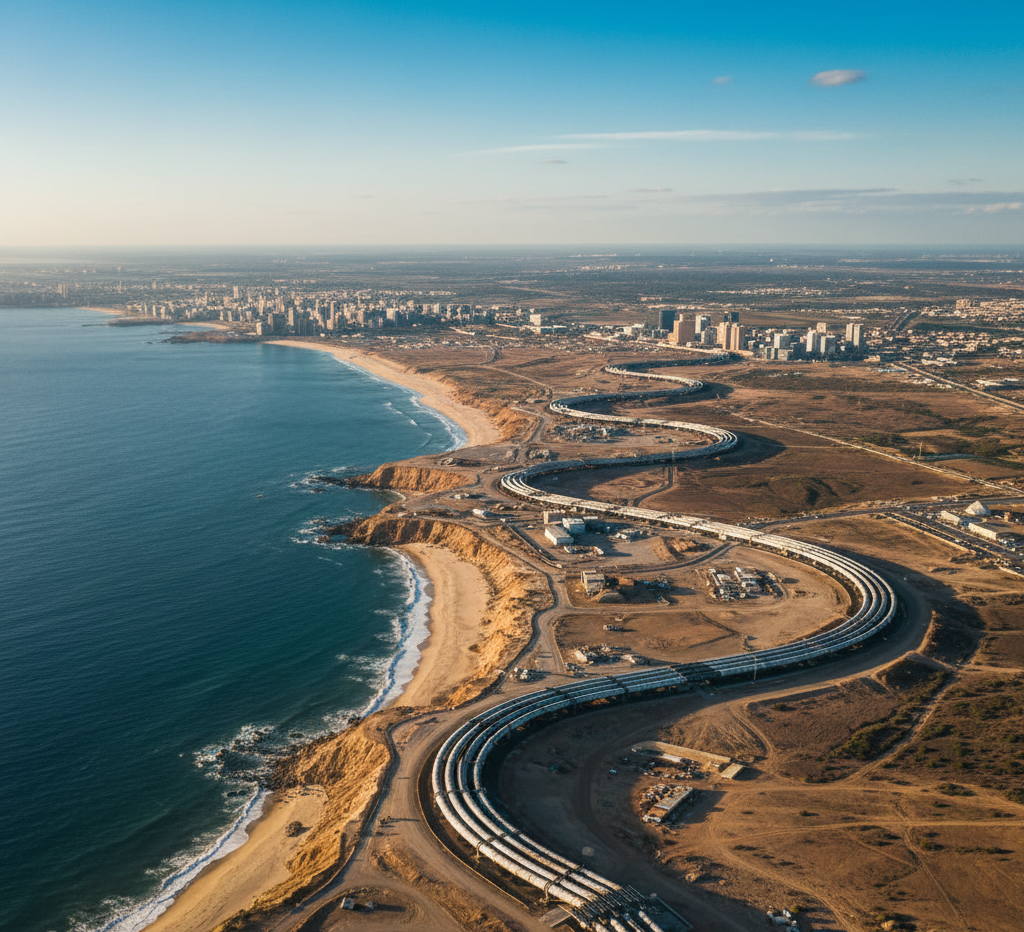
The pipeline’s routing along the Atlantic coastline, while adding distance compared to hypothetical inland routes, provides crucial advantages including access to coastal cities where energy demand concentrates, proximity to offshore gas fields that could supply additional feedstock, and avoidance of some politically unstable inland regions where security concerns would complicate construction and ongoing operations. The coastal route also simplifies certain logistical challenges around construction staging, equipment delivery, and ongoing maintenance access compared to pipelines traversing remote interior territories with limited infrastructure.
Integration with the existing Maghreb-Europe pipeline creates the project’s European market access, allowing Nigerian and West African gas to reach Spain and potentially other European markets through established infrastructure. This European connectivity transforms the NMGP from purely regional infrastructure into a component of global energy supply chains, giving participating African nations the ability to supply one of the world’s wealthiest, most energy-hungry markets. The resulting export revenue potential significantly improves project economics while giving West African producers leverage in negotiations with traditional gas suppliers who have historically dominated European markets.
For landlocked nations like Niger, Burkina Faso, and Mali, the pipeline represents a potential lifeline to energy access that geography has historically denied them. Spur connections from the main coastal pipeline could deliver natural gas to these interior nations, ending their dependence on expensive imported fuels and unreliable electricity grids. The transformative potential for landlocked nations may actually exceed the benefits for coastal states, as countries that have never enjoyed energy security could leapfrog directly to gas-powered generation and industrial processes without legacy infrastructure constraints.
Institutional and Financial Architecture
The NMGP’s institutional structure centers on establishing a dedicated project company designed to ensure transparency, attract international investors, and manage the complex multinational coordination that the pipeline requires. This special purpose entity will operate with governance structures reflecting participation from all transit and supply nations while maintaining professional management insulated from the political interference and corruption that has plagued many African infrastructure projects. The project company model allows private sector investment and international development finance while preserving national ownership stakes that ensure participating governments receive appropriate benefits from infrastructure crossing their territories.
The $25 billion funding model represents one of the largest infrastructure finance challenges ever undertaken by African nations, requiring sophisticated capital structures combining equity from participating governments and national oil companies, commercial debt from international banks, concessional financing from development finance institutions, and potentially equity participation from strategic partners including gas consumers and infrastructure investors. This financing complexity demands institutional sophistication and creditworthiness that some participating nations struggle to demonstrate, requiring creative risk allocation and guarantee structures that make the overall project bankable despite individual country credit concerns.
Development finance institutions including the African Development Bank, World Bank, and various bilateral development agencies have indicated preliminary support that could provide the concessional financing and political risk guarantees necessary to unlock commercial investment. However, DFI participation comes with conditions around environmental standards, social impact mitigation, and governance transparency that add project costs while providing accountability mechanisms that improve long-term sustainability. Balancing these requirements against the urgency of moving forward represents an ongoing challenge for project developers trying to finalize financing while maintaining development timelines.
The current project status involves finalization of comprehensive technical studies confirming route optimization, demand projections, cost estimates, and environmental impact assessments. These studies provide the technical foundation for financial close, allowing investors to underwrite risks with confidence that the project design reflects rigorous engineering analysis rather than political aspiration. Route confirmation particularly matters for landowner negotiations, environmental permitting, and construction logistics that cannot proceed until the precise pipeline path is definitively established and approved by all participating governments.
The Socio-Economic Multiplier Effect
The NMGP’s economic benefits extend far beyond the direct gas sales revenue that will accrue to Nigeria as the primary supplier. Transit fees paid by the project company to nations hosting pipeline infrastructure will generate substantial annual revenue for governments from Benin to Mauritania, creating predictable income streams that can finance development priorities, service debt, or build foreign currency reserves. These transit revenues represent payment for essentially passive infrastructure hosting—once the pipeline is built and operating, host nations receive ongoing fees without active management responsibilities or operational risks.
Addressing West Africa’s chronic electricity shortages through reliable domestic gas supply may ultimately prove the project’s most transformative impact. Currently, inadequate and unreliable electricity constrains economic activity across every sector, forcing businesses to invest in expensive backup generators, preventing industries from operating competitively, and leaving hundreds of millions without access to modern energy services. The NMGP can fundamentally change this reality by providing affordable feedstock for gas-fired power generation that operates reliably at scales matching national demand. Countries that currently suffer daily blackouts could transition to consistent electricity availability that enables economic activities currently impossible under perpetual power uncertainty.
Morocco’s strategic positioning as the bridge between Africa and Europe gains substantial reinforcement through the NMGP, as the kingdom becomes the critical connection point where West African gas enters European markets. This geographic advantage allows Morocco to capture transit fees, develop gas-dependent industries using competitively priced feedstock, and position itself as an indispensable energy partner to Europe at a moment when the continent desperately seeks to diversify away from Russian gas dependence. The geopolitical leverage created by controlling this chokepoint could prove extraordinarily valuable as European energy security concerns reshape global gas markets.
Beyond direct economic benefits, the project creates substantial employment during multi-year construction phases, develops local contracting and engineering capacity through technology transfer requirements, and demonstrates that African nations can successfully coordinate on complex infrastructure that creates broadly shared prosperity rather than zero-sum competition for limited resources.
Legal, Environmental, and Practical Hurdles
The NMGP’s multinational nature creates extraordinary legal complexity requiring International Intergovernmental Agreements (IGAs) establishing the rights, responsibilities, and revenue allocations among participating nations, and Host Government Agreements (HGAs) defining the specific terms under which the pipeline company can operate within each country’s territory. Negotiating these agreements requires balancing competing national interests, addressing sovereignty concerns about foreign infrastructure on domestic territory, and creating dispute resolution mechanisms that all parties trust will adjudicate conflicts fairly.
IGAs must address questions around pipeline capacity allocation when demand exceeds supply, responsibilities for security and maintenance across different national territories, regulatory coordination to prevent conflicting requirements that make operations impossible, and revenue sharing formulas that all participants consider equitable. The political sensitivity of these issues—where concessions made during negotiations can be attacked domestically as surrendering national interests—makes reaching agreement extraordinarily difficult even when all parties genuinely want the project to succeed.
Environmental concerns represent another major hurdle, with international NGOs protesting the project as fossil fuel expansion inconsistent with climate commitments and warnings about biodiversity risks in ecologically sensitive coastal regions the pipeline will traverse. These protests create reputational risks for development finance institutions considering project support, potentially triggering internal policy conflicts between infrastructure development mandates and climate commitments. Project developers must demonstrate that environmental safeguards meet international standards, that alternatives to gas-fired development are economically unrealistic for nations at West Africa’s development level, and that failing to build the pipeline would likely produce worse environmental outcomes as nations turn to even dirtier energy sources.
Land acquisition challenges affect thousands of communities along the pipeline route, requiring compensation agreements with property owners, resettlement of populations living in the pipeline’s right-of-way, and mitigation of socio-economic impacts on communities whose traditional livelihoods may be disrupted by construction. The ethical and practical complexity of these negotiations—conducted across multiple legal systems, languages, and cultural contexts—creates enormous administrative burdens while generating opportunities for corruption, conflicts, and delays that can derail entire projects.
Conclusion: A New Narrative for Africa
The Nigeria-Morocco Gas Pipeline represents more than infrastructure—it embodies a narrative shift from Africa as energy-dependent victim of global markets to the continent as strategic player leveraging natural resources for collective development. For too long, Africa’s energy story featured extraction by foreign companies, export of raw resources without value addition, and chronic domestic energy poverty despite abundant natural resources. The NMGP inverts this narrative by creating African-controlled infrastructure that delivers African gas to African consumers while generating revenue and development benefits that remain on the continent.
The project functions as a microcosm of Africa’s potential for mega-infrastructure that creates broadly shared prosperity rather than concentrating benefits among narrow elites or foreign interests. If successfully executed, the NMGP demonstrates that African nations can mobilize capital at unprecedented scales, coordinate across borders despite historical tensions, and deliver complex technical projects that meet international standards. These demonstrations matter enormously for investor confidence in future African infrastructure, as successful precedents reduce perceived risks and establish institutional models that subsequent projects can replicate.
The transition from energy dependency to potential global leadership in gas supply represents the project’s ultimate significance. West African nations could evolve from price-taking commodity exporters with no market power into strategic suppliers whose production decisions influence global markets, whose infrastructure investments shape international energy flows, and whose diplomatic partnerships matter to energy-hungry developed nations. This transformation from periphery to center, from dependent to essential, captures the broader possibilities that African development could realize through strategic infrastructure investments that leverage the continent’s natural advantages while building institutional capacity for managing complexity at global scales. The Nigeria-Morocco Gas Pipeline may take a decade to complete, but the narrative transformation it represents could reshape African development trajectories for generations.
Nigeria-Morocco Gas Pipeline – Energy Circle